Definition
ESR stands for erythrocyte sedimentation rate. It is commonly called a "sed rate."
It is a test that indirectly measures the level of certain proteins in the blood. This measurement correlates with the amount of inflammation in the body.
Alternative Names
Erythrocyte sedimentation rate; Sed rate; Sedimentation rate
How the Test is Performed
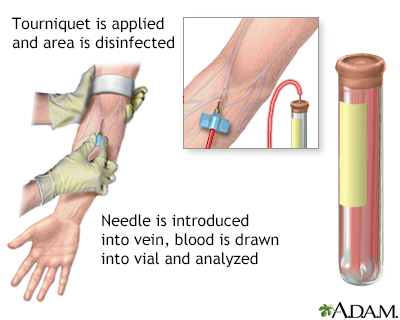
A blood sample is needed. Most of the time, blood is drawn from a vein located on the inside of the elbow or the back of the hand. The blood sample is sent to a lab.
The test measures how fast red blood cells (called erythrocytes) fall to the bottom of a tall, thin tube.
How to Prepare for the Test
There are no special steps needed to prepare for this test.
How the Test will Feel
You may feel slight pain or a sting when the needle is inserted. You may also feel some throbbing at the site after the blood is drawn.
Why the Test is Performed
Reasons why a "sed rate" may be done include:
- Unexplained fevers
- Certain types of joint pain or arthritis
- Muscle symptoms
- Headache
- Other vague symptoms that cannot be explained
This test may also be used to monitor whether an illness is responding to treatment.
It is not used to diagnose a specific disorder.
However, the test is useful for detecting and monitoring:
Normal Results
For adults (Westergren method):
- Men under 50 years old: less than 15 mm/hr
- Men over 50 years old: less than 20 mm/hr
- Women under 50 years old: less than 20 mm/hr
- Women over 50 years old: less than 30 mm/hr
For children (Westergren method):
- Newborn: 0 to 2 mm/hr
- Newborn to puberty: 3 to 13 mm/hr
Note: mm/hr = millimeters per hour
Normal value ranges may vary slightly among different labs. Talk to your health care provider about the meaning of your specific test results.
What Abnormal Results Mean
An abnormal ESR may help with a diagnosis, but it does not prove that you have a certain condition. Other tests are almost always needed.
An increased ESR rate may occur in people with:
The immune system helps protect the body against harmful substances. An autoimmune disorder is when the immune system mistakenly attacks and destroys healthy body tissue. ESR is often higher than normal in people with an autoimmune disorder.
Common autoimmune disorders include:
Very high ESR levels occur with less common autoimmune or other disorders, including:
An increased ESR rate may be due to some infections, including:
Lower-than-normal levels occur with:
References
Deane KD, Pisetsky DS. Laboratory testing in the rheumatic diseases. In: Goldman L, Cooney KA, eds. Goldman-Cecil Medicine. 27th ed. Philadelphia, PA: Elsevier; 2024:chap 237.
Vajpayee N, Graham SS, Bem S. Basic examination of blood and bone marrow. In: McPherson RA, Pincus MR, eds. Henry's Clinical Diagnosis and Management by Laboratory Methods. 24th ed. Philadelphia, PA: Elsevier; 2022:chap 31.