Fast heart rate - tachycardia
Definition
Tachycardia is when your heart beats faster than normal, above 100 beats per minute. Most adults have a normal resting heart rate from 60 to 100 beats per minute.
A fast heart rate can be a normal response to stress or exercise. Tachycardia can also be a sign of a more serious medical condition.
Alternative Names
Tachyarrhythmia; Polycardia; Fast heart rate; Rapid heartbeat
Causes
Normally, your heart works as a pump that sends blood to the lungs and the rest of the body.
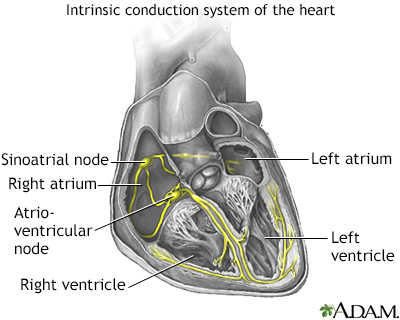
To help this happen, your heart has an electrical system that makes sure it squeezes (contracts) in an orderly way. This process includes:
- The electrical impulse that signals your heart to contract begins in an area of the heart called the sinoatrial node (also called the sinus node or SA node). This is your heart's natural pacemaker.
- The signal leaves the SA node and travels through the heart along a set electrical pathway.
- Different nerve messages signal your heart to beat slower or faster.
If your heart beats too fast, its lower chambers (ventricles) don't get enough time to fill up with blood between beats. As a result, the heart cannot pump enough blood and oxygen throughout your body.
There are many different ways to categorize tachycardias.
- One kind called supraventricular tachycardia (SVT) starts in the upper chambers of the heart. There are several types of this kind.
- The other kind starts in the lower chambers of the heart. Ventricular tachycardia (VT) and ventricular fibrillation (VF) are the two main types of this kind.
Causes of a fast heart rate range from harmless conditions to medical emergencies. They can include:
- Temporary causes such as stress and anxiety, fever, vigorous exercise, pain, and infection
- Overuse of caffeine, tobacco, or alcohol
- Pregnancy
- Anemia
- Coronary heart disease
- Congenital heart disease
- Cardiomyopathy
- Heart diseases that cause the electrical system to malfunction
- Lung conditions such as chronic lung disease and pulmonary embolism
- Shock
- Hyperthyroidism
- Dehydration
- Low blood sugar (hypoglycemia)
- Medicines such as albuterol, atropine, and antihistamines
- Illegal drug use
- Withdrawal from substances or certain medicines
Symptoms
Symptoms of tachycardia can include:
- Heart palpitations
- Fluttering feeling in the chest and neck
- Shortness of breath
- Hot flashes and sweating
- Dizziness
- Lightheadedness
- Confusion
- Fainting (syncope) or near fainting
- Low blood pressure (hypotension)
Sometimes there may be no symptoms and a fast heart rate is detected by your health care provider or by a smartwatch or fitness tracker.
Exams and Tests
Your health care provider will ask about your medical history and the medicines you are taking. Your provider will do a physical exam and listen to your heart with a stethoscope for heart murmurs or other abnormal sounds. Your blood pressure and pulse rate will be measured.
Your provider may order the following tests:
- Electrocardiogram (ECG)
- 24-hour Holter or event monitor recording
- Electrophysiology study (EPS)
- Echocardiogram
- Exercise stress test
- Tilt table test
- Chest x-ray
- Chest CT scan
- Lung ventilation-perfusion scan
- Blood glucose, electrolyte, and thyroid hormone levels
- Complete blood count (CBC)
Treatment
Treatment depends upon the type of tachycardia you have, what's causing it, and the severity of your symptoms. If your symptoms last only for a short time and are due to temporary reasons, such as strong emotions or exercise, you may not need treatment.
If you have an underlying medical condition, it will be diagnosed and treated by your provider. Your provider may tell you to avoid triggers such as tobacco and caffeine. If medicines are the cause of tachycardia, your provider may lower the dose or change the medicine.
Your provider may recommend the following treatments:
- Medicines such as beta-blockers, calcium-channel blockers, sodium and potassium channel blockers, and blood thinners
- Vagal maneuvers (simple exercises to stimulate the vagus nerve to slow down the heart rate)
- Cardioversion (using electric shock or medicines)
- Cardiac ablation
- Implantable cardiac defibrillator (ICD)
- Pacemaker
In case of emergency, you may need:
- Medicines through the vein (intravenous, or IV)
- CPR
Outlook (Prognosis)
The outlook depends upon:
- The type of tachycardia you have
- Your heart function
- The underlying cause
Once the trigger is removed or managed (such as medicine, caffeine, stress), your heart rate usually returns to normal. If an underlying disease is the cause, early diagnosis and treatment will help lower the risk for complications.
Possible Complications
Untreated, regular episodes of tachycardia may lead to the following complications:
- Frequent fainting
- Cardiomyopathy
- Blood clots
- Heart attack
- Organ failure
- Stroke
- Cardiac arrest
- Death
When to Contact a Medical Professional
Contact your provider if:
- You develop any of the symptoms of tachycardia that do not go away within a few minutes
- You experience frequent episodes of tachycardia
- You have been diagnosed with tachycardia and your symptoms get worse or do not improve with treatment
Call 911 or the local emergency number right away if you have:
- Rapid, irregular pulse
- Chest pain
- Breathlessness
- Very low blood pressure
- Fainting
Prevention
Not all cases of tachycardia can be prevented. Taking steps to prevent coronary artery disease may help reduce your chance of developing heart rate problems.
Gallery

References
American Heart Association website. Tachycardia: fast heart rate. www.heart.org/en/health-topics/arrhythmia/about-arrhythmia/tachycardia--fast-heart-rate. Updated September 24, 2024. Accessed July 22, 2026.
Kalman JM, Sanders P. Supraventricular tachycardias. In: Bonow RO, Mann DL, Tomaselli GF, et al, eds. Braunwald's Heart Disease: A Textbook of Cardiovascular Medicine. 13th ed. Philadelphia, PA: Elsevier; 2026:chap 47.
Zimetbaum P, Goldman L. Supraventricular ectopy and tachyarrhythmias. In: Goldman L, Cooney KA, eds. Goldman-Cecil Medicine. 27th ed. Philadelphia, PA: Elsevier; 2024:chap 52.