HDL Test
Definition
The high-density lipoprotein (HDL) test is a blood test to measure the amount of HDL cholesterol in your blood. HDL is a type of fat (lipid) in your blood.
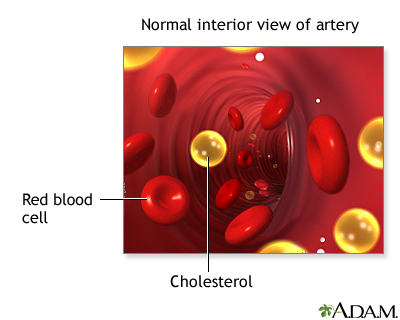
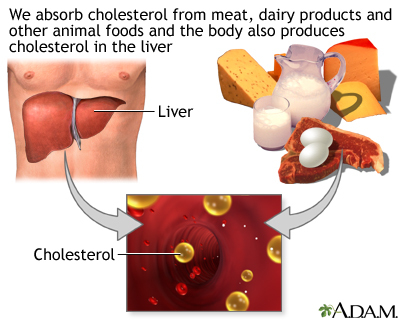
HDL is called "good" cholesterol because it helps prevent low-density lipoprotein (LDL) "bad" cholesterol and triglycerides from building up in the arteries. HDL picks up LDL in the blood and carries it to the liver. The liver breaks down LDL cholesterol, and it is passed from the body as waste.
The HDL test is often done as part of a lipid profile, which measures the fats in your blood:
- Total cholesterol
- HDL cholesterol
- LDL cholesterol
- Triglycerides
- Very low-density lipoprotein cholesterol, VLDL cholesterol (which is usually calculated from the triglyceride level rather than measured directly)
Alternative Names
HDL cholesterol; High-density lipoprotein (HDL) cholesterol levels
How the Test is Performed
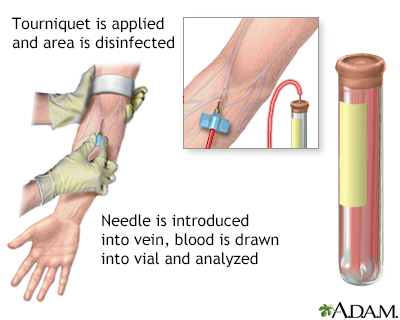
A blood sample is needed. Most of the time, blood is drawn from a vein located on the inside of the elbow or the back of the hand.
How to Prepare for the Test
Ideally, you should not eat for 9 to 12 hours before the test. But the test can be done if you have eaten.
Alcohol and some medicines can interfere with blood test results.
- Make sure your health care provider knows what medicines you take, including over-the-counter medicines and supplements.
- Your provider will tell you if you need to stop taking any medicines before you have this test.
- Do not stop or change your medicines without talking to your provider first.
How the Test will Feel
You may feel slight pain or a sting when the needle is inserted. You may also feel some throbbing at the site after the blood is drawn.
Why the Test is Performed
HDL cholesterol is usually measured together with other blood fats. Often it is done to help determine your risk of developing heart disease.
High HDL helps lower your risk for:
Normal Results
You want your HDL cholesterol to be high (unless it is due to a condition described below). Optimal values are 60 mg/dL or 1.55 millimoles per liter (mmol/L) or above.
At risk:
- Men - Less than 40 mg/dL (1.04 mmol/L)
- Women - Less than 50 mg/dL (1.29 mmol/L)
Normal value ranges may vary slightly among different laboratories. Talk to your provider about the meaning of your specific test results.
What Abnormal Results Mean
Low HDL cholesterol levels may be due to:
- Eating a diet high in saturated fats or a diet high in carbohydrates and low in fat
- Lack of physical activity
- Being overweight or having obesity
- Metabolic syndrome
- Diabetes
- A disorder passed down through families in which there are high amounts of cholesterol and triglycerides in the blood (familial combined hyperlipidemia)
- Side effect of certain medicines
Overall, the treatment of low HDL focuses on increased exercise and changes in the diet.
An elevated HDL is anything over 80 mg/dL (2.0 mmol/L). This can be a result of:
- A genetic variation that causes the body to produce too much HDL
- Overactive thyroid (hyperthyroidism)
- Drinking too much alcohol
Risks
There is little risk involved with having your blood taken. Veins and arteries vary in size from one person to another and from one side of the body to the other. Taking blood from some people may be more difficult than from others.
Other risks associated with having blood drawn are slight, but may include:
Considerations
Certain medicines, pregnancy, infection, and some medical conditions can affect test results.
Gallery
References
Blumenthal RS, Morris PB, Gaudino M, et al. 2026 ACC/AHA/AACVPR/ABC/ACPM/ADA/AGS/APhA/ASPC/NLA/PCNA Guideline on the Management of Dyslipidemia: A Report of the American College of Cardiology/American Heart Association Joint Committee on Clinical Practice Guidelines. Circulation. 2026 Apr 28;153(17):e1154-e1276. Epub 2026 Mar 13. PMID: 41824552. pubmed.ncbi.nlm.nih.gov/41824552/.
Bredefeld CL, Lau R, Hussain MM. Lipids and dyslipoproteinemia. In: McPherson RA, Pincus MR, eds. Henry's Clinical Diagnosis and Management by Laboratory Methods. 24th ed. Philadelphia, PA: Elsevier; 2022:chap 18.
Mora S, Libby P, Ridker PM. Primary prevention of cardiovascular disease. In: Bonow RO, Mann DL, Tomaselli GF, et al, eds. Braunwald's Heart Disease: A Textbook of Cardiovascular Medicine. 13th ed. Philadelphia, PA: Elsevier; 2026:chap 23.
Robinson JG. Disorders of lipid metabolism. In: Goldman L, Cooney KA, eds. Goldman-Cecil Medicine. 27th ed. Philadelphia, PA: Elsevier; 2024:chap 190.
Tokgözoglu L, Libby P. Lipoprotein disorders and cardiovascular disease. In: Bonow RO, Mann DL, Tomaselli GF, et al, eds. Braunwald's Heart Disease: A Textbook of Cardiovascular Medicine. 13th ed. Philadelphia, PA: Elsevier; 2026:chap 25.