Potential Acuity Meter
Definition
A potential acuity meter is an instrument used to examine the eyes. Your health care provider can use this tool to predict how well you may see after eye surgery. People who have reduced vision due to cataracts may also have other reasons for poor vision. The potential acuity meter will help predict what their vision will be after the cataracts are removed. If cataracts are severe, the instrument may not give useful information.
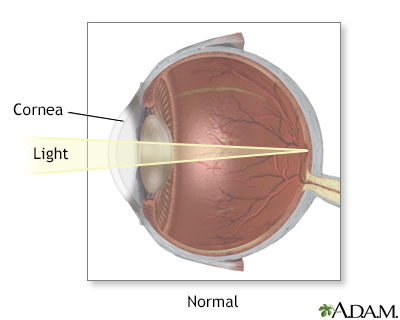
The potential acuity meter measures how well the retina can see, so it is not affected by the blurriness caused by conditions like cataracts. This is because the device projects a vision chart directly onto the retina, bypassing conditions like cataracts.
The potential acuity meter can help to separate the effect of the two conditions and more accurately predict the improvement in vision from cataract surgery.
Alternative Names
PAM
Gallery
References
Lundström M. Outcomes of cataract surgery. In: Yanoff M, Duker JS, eds. Ophthalmology. 6th ed. Philadelphia, PA: Elsevier; 2023:chap 5.21.
Stein HA, Stein R, AlShaker SM. Preliminary examination. In: Stein HA, Stein RM, Freeman MI, Stein RL, eds. The Ophthalmic Assistant, The. 11th ed. Philadelphia, PA: Elsevier; 2023:chap 8.