Apolipoprotein B100
Definition
Apolipoprotein B (ApoB) is a protein that plays a role in moving cholesterol around your body. It is a form of low density lipoprotein (LDL).
Variants in the gene that directs the body's production of ApoB100 can cause a condition called familial hypercholesterolemia. This is a form of high blood cholesterol that is passed down in families (inherited).
This article discusses the test used to measure the level of ApoB100 in the blood.
Alternative Names
ApoB100; Apoprotein B100; Hypercholesterolemia - apolipoprotein B100; Apolipoprotein B100; ApoB
How the Test is Performed
How to Prepare for the Test
Your health care provider may tell you not to eat or drink anything for 4 to 6 hours before the test.
How the Test will Feel
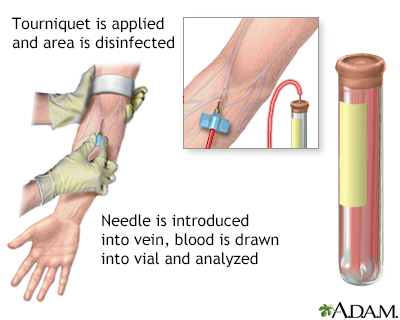
When the needle is inserted to draw blood, you may feel moderate pain, or only a prick or stinging sensation. Afterward, there may be some throbbing.
Why the Test is Performed
Most often, this test is done to help determine the cause or specific type of high blood cholesterol. How much this test adds to standard cholesterol testing is not known, but it is recommended by the American College of Cardiology and American Heart Association to help guide your treatment.
Normal Results
The normal range is about 50 to 150 mg/dL.
Normal value ranges may vary slightly among different laboratories. Some laboratories use different measurements or may test different specimens. Talk to your provider about the meaning of your specific test results.
What Abnormal Results Mean
An abnormal result may mean you have high lipid (fat) levels in your blood. A medical term for this is hyperlipidemia. An abnormal result may indicate you have a high risk of heart disease even if your cholesterol levels are at a target level with treatment.
Other disorders that may be associated with high ApoB levels include atherosclerotic vascular disease such as angina pectoris (chest pain that occurs with activity or stress) and heart attack.
Risks
Risks linked with having blood drawn are slight, but may include:
- Excessive bleeding
- Fainting or feeling lightheaded
- Hematoma (blood buildup under the skin)
- Infection (a slight risk any time the skin is broken)
- Multiple punctures to locate veins
Considerations
ApoB measurements may provide more detail about your risk for heart disease. The results may lead to intensification of lipid therapies, especially in patients with atherosclerotic heart disease or to aid in risk assessment prior to starting lipid therapy and to evaluate for inherited lipid disorders.
Gallery
References
Bredefeld CL, Lau R, Hussain MM. Lipids and dyslipoproteinemia. In: McPherson RA, Pincus MR, eds. Henry's Clinical Diagnosis and Management by Laboratory Methods. 24th ed. St Louis, MO: Elsevier; 2022:chap 18.
Mora S, Martin SS. Measurement of low-density lipoprotein cholesterol, non-high-density lipoprotein cholesterol, apolipoprotein B, and low-density lipoprotein particle concentration. In: Ballantyne CM, ed. Clinical Lipidology: A Companion to Braunwald's Heart Disease. 3rd ed. Philadelphia, PA: Elsevier; 2024:chap 3.
Robinson JG. Disorders of lipid metabolism. In: Goldman L, Cooney KA, eds. Goldman-Cecil Medicine. 27th ed. Philadelphia, PA: Elsevier; 2024:chap 190.
Tokgözoglu L, Libby P. Lipoprotein disorders and cardiovascular disease. In: Bonow RO, Mann DL, Tomaselli GF, et al, eds. Braunwald's Heart Disease: A Textbook of Cardiovascular Medicine. 13th ed. Philadelphia, PA: Elsevier; 2026:chap 25.
Writing Committee Members, Blumenthal RS, Morris PB, et al. 2026 ACC/AHA/AACVPR/ABC/ACPM/ADA/AGS/APhA/ASPC/NLA/PCNA Guideline on the management of dyslipidemia: a report of the American College of Cardiology/American Heart Association Joint Committee on Clinical Practice Guidelines. Circulation. 2026;153(17):e1154-e1276. PMID: 41824552 pubmed.ncbi.nlm.nih.gov/41824552/.