
Definition

The ciliary body is a circular structure that is an extension of the iris, the colored part of the eye. The ciliary body produces the fluid in the eye called aqueous humor. It also contains the ciliary muscle, which changes the shape of the lens when your eyes focus on a near object. This process is called accommodation.

A type of tumor called melanoma can develop in the iris. Most eye melanomas form in the part of the eye that you cannot see in the mirror and therefore they can be difficult to detect. Early melanomas do not cause any symptoms making them hard to diagnose.

Gallery
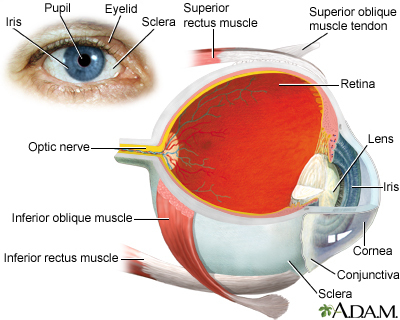
Eye
The eye is the organ of sight, a nearly spherical hollow globe filled with fluids (humors). The outer layer or tunic (sclera, or white, and cornea) is fibrous and protective. The middle layer (choroid, ciliary body and the iris) is vascular. The innermost layer (the retina) is nervous or sensory. The fluids in the eye are divided by the lens into the vitreous humor (behind the lens) and the aqueous humor (in front of the lens). The lens itself is flexible and suspended by ligaments which allow it to change shape to focus light on the retina, which is composed of sensory neurons.

References

Evans M. Anatomy of the uvea. In: Yanoff M, Duker JS, eds. Ophthalmology. 6th ed. Philadelphia, PA: Elsevier; 2023:chap 7.1.

Stålhammar G, Coupland SE, Ewens KG, et al. Improved staging of ciliary body and choroidal melanomas based on estimation of tumor volume and competing risk analyses. Ophthalmology. 2024;131(4):478-491. PMID: 38071620 pubmed.ncbi.nlm.nih.gov/38071620/.

Standring S. Eye. In: Standring S, ed. Gray's Anatomy: The Anatomical Basis of Clinical Practice. 42nd ed. Philadelphia, PA: Elsevier; 2021:chap 45.

Last reviewed July 24, 2025 by Franklin W. Lusby, MD, Ophthalmologist, Lusby Vision Institute, La Jolla, CA. Also reviewed by David C. Dugdale, MD, Medical Director, Brenda Conaway, Editorial Director, and the A.D.A.M. Editorial team..

Related specialties