Sclera
Definition
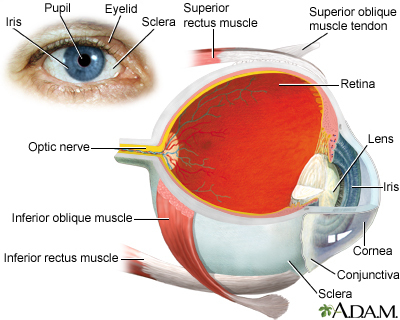
The sclera is the white outer coating of the eye. It is tough, fibrous tissue that extends from the cornea (the clear front section of the eye) to the optic nerve at the back of the eye. The sclera gives the eyeball its white color. The cornea and sclera are made of the same type of collagen fibers. In the cornea, the fibers are arranged in sheets and layers which makes the cornea clear. In the sclera, the fibers are arranged randomly. Factors like scleral elasticity are associated with the development of nearsightedness or myopia.
Gallery
References
Lawrenson JG, Powner MB. Eye. In: Standring S, Tubbs RS, Anand N, et al, eds. Gray's Anatomy: The Anatomical Basis of Clinical Practice. 43rd ed. Philadelphia, PA: Elsevier; 2026:chap 48.
Mehta JS, Ang M. Cornea and sclera. In: Levin LA, Kaufman PL, Hartnett ME, eds. Adler's Physiology of the Eye. 12th ed. Philadelphia, PA: Elsevier; 2025:chap 4.
Taber's Cyclopedic Medical Dictionary. Sclera. 24th ed. Philadelphia, PA: F.A. Davis Company; 2021. www.tabers.com/tabersonline/view/Tabers-Dictionary/748617/all/sclera. Accessed August 13, 2025.