Abdominal Exploration
Definition
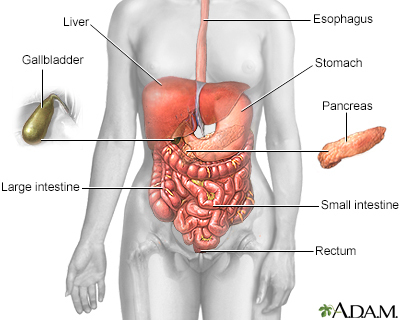
Abdominal exploration is surgery to look at the organs and structures in your belly area (abdomen). This includes your:
- Appendix
- Bladder
- Gallbladder
- Intestines
- Kidney and ureters
- Liver
- Pancreas
- Spleen
- Stomach
- Uterus, fallopian tubes, and ovaries (in women)
Surgery that opens the abdomen is called a laparotomy.
Alternative Names
Exploratory surgery; Laparotomy; Exploratory laparotomy
Description
Exploratory laparotomy is done while you are under general anesthesia. This means you are asleep and feel no pain.
Your surgeon makes a cut into the abdomen and examines the abdominal organs. The size and location of the surgical cut depend on the specific health concern.
A biopsy can be taken during the procedure.
Laparoscopy describes a procedure that is performed with a tiny camera placed inside the abdomen. If possible, laparoscopy will be done instead of laparotomy.
Why the Procedure Is Performed
Your health care provider may recommend a laparotomy if imaging tests of the abdomen, such as x-rays and CT scans, have not provided an accurate diagnosis.
Exploratory laparotomy may be used to help diagnose and treat many health conditions, including:
- Blockage (obstruction) of the intestine
- Cancer of the ovary, colon, pancreas, liver
- Endometriosis
- Gallstones
- Hole in the intestine (intestinal perforation)
- Acute appendicitis
- Diverticulitis
- Acute or chronic pancreatitis
- Liver abscess
- Pockets of infection (retroperitoneal abscess, abdominal abscess, pelvic abscess)
- Pregnancy outside of the uterus (ectopic pregnancy)
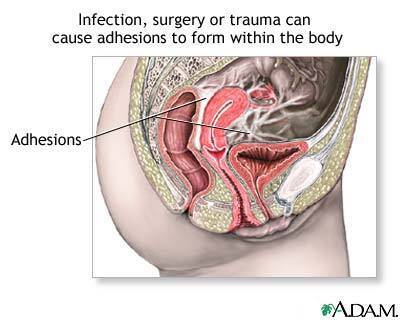
- Scar tissue in the abdomen (adhesions)
Risks
Risks of anesthesia and surgery in general include:
- Reactions to medicines
- Breathing problems
- Bleeding, blood clots, infection
Risks of this surgery include:
- Incisional hernia
- Damage to organs in the abdomen
Before the Procedure
Planning for surgery:
- Your provider will do a complete physical exam.
- Your provider will perform tests to make sure that you will be able to tolerate surgery.
- If you have diabetes, heart disease, or other medical conditions, your surgeon may ask you to see the provider who treats you for these conditions.
- If you smoke, it's important to cut back or quit. Smoking can slow healing and increase the risk for blood clots. Ask your provider for help quitting smoking.
- If needed, prepare your home to make it easier to recover after surgery.
- Ask your surgeon if you need to arrange to have someone drive you home after your surgery.
Tell your surgeon or nurse if:
- You are or could be pregnant
- You are taking any medicines, including medicines, drugs, supplements, or herbs you bought without a prescription
- You have been drinking a lot of alcohol, more than 1 or 2 drinks a day
During the week before your surgery:
- You may be asked to temporarily stop taking medicines that keep your blood from clotting. These medicines are called blood thinners. This includes over-the-counter medicines and supplements such as aspirin, ibuprofen (Advil, Motrin), naproxen (Aleve, Naprosyn), and vitamin E. Many prescription medicines are also blood thinners.
- Ask your surgeon which medicines you should still take on the day of surgery.
- Let your surgeon know about any illness you may have before your surgery. This includes COVID-19, a cold, flu, fever, herpes outbreak, or other illness. If you do get sick, your surgery may need to be postponed.
On the day of surgery:
- Follow instructions about when to stop eating and drinking.
- Take the medicines your surgeon told you to take with a small sip of water.
- Follow instructions on when to arrive at the hospital. Be sure to arrive on time.
Outlook (Prognosis)
You should be able to start eating and drinking normally about 1 to 3 days after the surgery, depending on how it was done and what the operation required. How long you stay in the hospital depends on the severity of the problem. Complete recovery usually takes about 4 to 6 weeks.
Gallery

References
Millham FH. Acute abdominal pain. In: Chung RT, Rubin DT, Wilcox CM, eds. Sleisenger and Fordtran's Gastrointestinal and Liver Disease: Pathophysiology/Diagnosis/Management. 12th ed. Philadelphia, PA: Elsevier; 2026:chap 12.
Ritter KA, Junak MI, Scarborough JE, Ho VP. The acute abdomen. In: Tyler DS, Hayes-Dixon A, Hines OJ, eds. Sabiston Textbook of Surgery. 22nd ed. Philadelphia, PA: Elsevier; 2026:chap 85.