Steve Took a Chance on a New Treatment, Now He’s Cancer-Free
There seemed to be no more wiggle room — the walls were closing in on Steve Hurm. Five years of fighting prostate cancer only felt like delaying the inevitable…

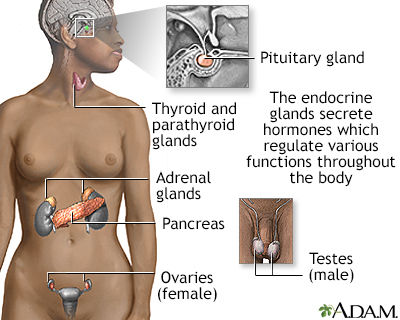
The adrenal glands are two small triangle-shaped glands in the upper abdomen. One gland is located on top of each kidney.
Each adrenal gland is about the size of the top part of the thumb. The outer part of the gland is called the cortex. It produces steroid hormones such as cortisol, aldosterone, and hormones that can be changed into testosterone. The inner part of the gland is called the medulla. It produces epinephrine and norepinephrine. These hormones are also called adrenaline and noradrenaline.
When the glands produce more or less hormones than normal, you can become sick. This might happen at birth or later in life.
The adrenal glands can be affected by many diseases, such as autoimmune disorders, infections, tumors, and bleeding. Some are permanent and some go away over time. Medicines can also affect the adrenal glands.
The pituitary, a small gland at the bottom of the brain, releases a hormone called adrenocorticotropic hormone (ACTH) that stimulates the adrenal cortex to make its hormones. Pituitary diseases can lead to problems with adrenal function.
Conditions related to adrenal gland problems include:
Also, taking glucocorticoid medicines, such as prednisone, methylprednisolone, dexamethasone, and hydrocortisone, can cause adrenal gland problems.

Auchus RJ, Pandey CEF. The adrenal cortex. In: Melmed S, Auchus RJ, Goldfine AB, Rosen CJ, Kopp PA, eds. Williams Textbook of Endocrinology. 15th ed. Philadelphia, PA: Elsevier; 2025:chap 13.
Berber E. Suprarenal gland. In: Standring S, Tubbs RS, Anand N, Catani M, Collins P, Crossman AR, et al, eds. Gray's Anatomy. 43rd ed. Philadelphia, PA: Elsevier; 2026:chap 73.
Nieman LK. Adrenal cortex. In: Goldman L, Cooney KA, eds. Goldman-Cecil Medicine. 27th ed. Philadelphia, PA: Elsevier; 2024:chap 208.
Young WF. Adrenal medulla, catecholamines, and pheochromocytoma. In: Goldman L, Cooney KA, eds. Goldman-Cecil Medicine. 27th ed. Philadelphia, PA: Elsevier; 2024:chap 209.
There seemed to be no more wiggle room — the walls were closing in on Steve Hurm. Five years of fighting prostate cancer only felt like delaying the inevitable…
October 7, 2024
In recognition of providing the most advanced treatments for patients with rare neuroendocrine tumors, as well as access to a coordinated team of experts, UF…
UF Health Cancer Institute, +1 more
