
To assess the safety and effectiveness of the ASG device in the treatment of de novo Type A aortic dissections.
- Investigator
- Thomas M Beaver
- Status
- Accepting Candidates
- Ages
- 18 Years - N/A
- Sexes
- All
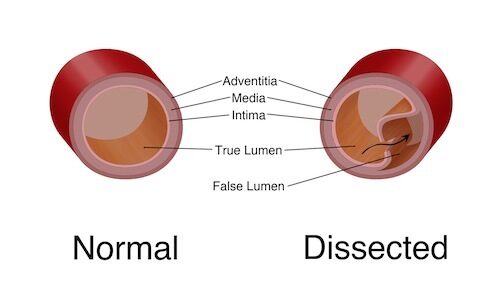
An aortic dissection is a tear in the inner wall of the aorta, the main blood vessel that travels from the heart. When this tear occurs, blood can flow through the layers of the aortic wall, weakening the aorta and potentially blocking blood flow downstream. These life-threatening effects can lead to aortic rupture or an inadequate supply of oxygenated blood, known as malperfusion, to critical organs (brain, kidneys, intestines, etc. ).
Yes, aortic dissections are classified as either Stanford Type A (Debakey Types I and II) or Stanford Type B (Debakey Type III):
Stanford Type A (Debakey Types I and II): Occurs in the ascending aorta and/or aortic arch with possible extension into the descending thoracic aorta.
Stanford Type B (Debakey Type III): Occurs in the descending thoracic and/or abdominal aorta only.
Aortic dissection is a rare condition, but it most often affects:
Adults ages 60 and older.
Men, more commonly than women
People with high blood pressure (the leading risk factor)
Individuals with aortic aneurysms or prior heart conditions
Genetic disorders that affect connective tissue, such as Marfan syndrome, Ehlers-Danlos syndrome, and Loeys-Dietz syndrome
People with a family history of aortic disease
Other contributing factors may include smoking, trauma, or stimulant drug use.
The exact cause of aortic dissection is still unknown, but there are several associated risk factors, including:
Aortic inflammation (Aortitis)
Atherosclerosis (buildup of plaque in the arteries)
An existing aneurysm
Chronic high blood pressure
Congenital anomalies (bicuspid aortic valve or aortic coarctation)
Trauma
Symptoms of an aortic dissection usually begin suddenly and can be severe.
The most common symptom of an aortic dissection is terrible, constant, ripping/tearing chest pain that may migrate to the upper back, neck, or abdomen. Other symptoms may include:
Shortness of breath
Fainting or dizziness
Weakness, trouble speaking, or other stroke-like symptoms
Rapid pulse or low blood pressure
Because symptoms can mimic a heart attack or stroke, diagnosis can be delayed. Immediate evaluation is critical.
Aortic dissection is a medical emergency and requires rapid diagnosis.
In addition to your physician getting your complete medical history and doing a physical exam, they may order any of the following tests:
CT scan (the most common and fastest imaging tool)
MRI
Transesophageal echocardiogram (TEE)
Chest X-ray (may show changes, but is not definitive)
Early diagnosis greatly improves survival.
In most cases, an aortic dissection is a life-threatening emergency, and immediate treatment is needed. All patients require medications to lower blood pressure and decrease the force of blood against the aortic wall. The decision to treat an aortic dissection with surgery is a complicated one and depends on multiple factors, including:
Type of dissection [Stanford Type A (Debakey Types I and II) vs Stanford Type B (Debakey Type III)]
Malperfusion of end organs (intestines, kidneys, etc.)
Diameter of the aorta
Persistent chest pain
High blood pressure that does not respond to treatment or control
If requiring surgery, a Type A dissection typically requires an open operation where the surgeon replaces the diseased portion of the aorta with a synthetic tube. The aortic valve may also need to be replaced.
If requiring surgery, Stanford Type B (Debakey Type III) dissections can often be treated with thoracic endovascular aortic repair (TEVAR), in which a stent-graft is deployed through minimally invasive means into the aorta.
Regardless of treating an aortic dissection with medications or surgery, it is critical that all patients undergo long-term monitoring with ongoing, repeated CT scans, as the aorta is at high risk of degeneration (becoming aneurysmal) over time.
No. An aneurysm is a bulge in the aorta, while a dissection is a tear. However, an aneurysm can increase the risk of a dissection.
It is a life-threatening emergency. Without treatment, complications such as rupture or organ damage can occur quickly.
Risk can be reduced by:
Controlling blood pressure
Avoiding smoking
Managing cholesterol
Monitoring known aortic conditions
Survival depends on how quickly treatment begins. Early diagnosis and care greatly improve outcomes.
If there is a family history or a known genetic condition, screening may be recommended. The UF Health Aortic Disease Center has genetic counselors on our team to help patients make decisions with as much information available as possible.
At UF Health, patients with aortic dissection receive care from a highly specialized, multidisciplinary team experienced in managing both routine and complex aortic conditions. This team includes cardiothoracic surgeons, vascular surgeons, cardiologists, imaging experts, genetic counselors, therapists and more. From rapid diagnosis to advanced surgical and minimally invasive treatments, care is personalized to each patient’s needs.
If you or a loved one may be at risk, call the UF Health Aortic Disease Center at 352-273-5494 to learn more about screening, diagnosis and treatment options.
This entry was written by Gabrielle Massari, Marketing Content Writer, and reviewed for accuracy by Eric Jeng, MD. Generative AI was leveraged as part of the content creation process.
UF Health research scientists make medicine better every day. They discover new ways to help people by running clinical trials. When you join a clinical trial, you can get advanced medical care. Sometimes years before it's available everywhere. You can also help make medicine better for everyone else. If you'd like to learn more about clinical trials, visit our clinical trials page. Or click one of the links below:
To assess the safety and effectiveness of the ASG device in the treatment of de novo Type A aortic dissections.
The goal of this clinical trial is to learn if the Arcevo LSA stent graft can safely and effectively treat patients that have an acute or chronic aortic dissection and/or aneurysm that involves the aortic arch and the descending thoracic aorta, with…
UF Health Wellness University is kicking off December with four free seminars on Thursday at the Hilton University of Florida Conference Center. Those…