How Surviving Childhood Leukemia Shaped Amanda Talley’s Future
Amanda Talley sometimes thinks about the numbers. Five: The age she was diagnosed with a fast-growing blood cancer. Three: The years she spent undergoing…

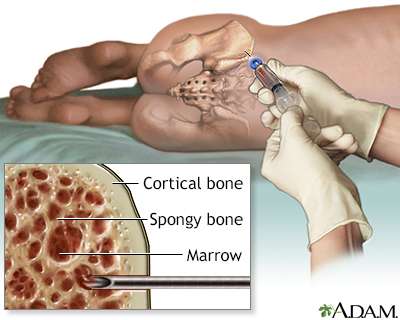
A bone marrow biopsy is the removal of marrow from inside one of your bones. Bone marrow is the soft tissue inside bones that helps form blood cells. It is found in the hollow part of most bones.
Bone marrow biopsy is not the same as bone marrow aspiration. An aspiration removes a small amount of marrow in liquid form for examination.
Biopsy - bone marrow
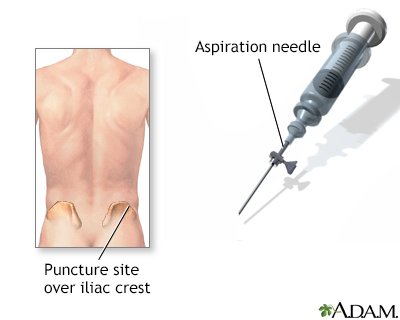
A bone marrow biopsy may be done in your health care provider's office or in a hospital. The sample is usually taken from the pelvic bone. Sometimes, another bone site is used.
Marrow is removed in the following steps:
A bone marrow aspiration may also be done, usually before the biopsy is taken. After the skin is numbed, the needle is inserted into the bone, and a syringe is used to withdraw the liquid bone marrow. If this is done, the needle will be removed and repositioned. Or, another needle may be used for the biopsy.
Tell your provider:
You will feel a sharp sting when the numbing medicine is injected. The biopsy needle may also cause a brief, usually dull, pain. Since the inside of the bone cannot be numbed, this test may cause some discomfort.
If a bone marrow aspiration is also done, you will feel a brief, sharp pain as the bone marrow liquid is removed.
Your provider may order this test if you have abnormal types or numbers of red or white blood cells or platelets on a complete blood count (CBC).
This test is used to diagnose:
It may also be used to help determine if a cancer has spread or responded to treatment.
A normal result means the bone marrow contains the proper number and types of blood-forming (hematopoietic) cells, fat cells, and connective tissues.
The results may detect the cause of anemia (too few red blood cells), abnormal white blood cells, or thrombocytopenia (too few platelets).
Abnormal results may be due to bone marrow cancers, including:
Abnormal results may also be due to other causes, such as:
There may be some bleeding at the puncture site. More serious risks, such as serious bleeding or infection, are very rare.
Choby BA. Bone marrow aspiration and biopsy. In: Fowler GC, ed. Pfenninger and Fowler's Procedures for Primary Care. 4th ed. Philadelphia, PA: Elsevier; 2020:chap 220.
DeZern AE, Brodsky RA. Aplastic anemia and related bone marrow failure states. In: Goldman L, Cooney KA, eds. Goldman-Cecil Medicine. 27th ed. Philadelphia, PA: Elsevier; 2024:chap 151.
Vajpayee N, Graham SS, Bem S. Basic examination of blood and bone marrow. In: McPherson RA, Pincus MR, eds. Henry's Clinical Diagnosis and Management by Laboratory Methods. 24th ed. Philadelphia, PA: Elsevier; 2022:chap 31.
Amanda Talley sometimes thinks about the numbers. Five: The age she was diagnosed with a fast-growing blood cancer. Three: The years she spent undergoing…
Anthony Macchio was already familiar with UF Health Shands Children’s Hospital. After his second daughter, Isabel, was born with a heart defect in February…
