Conjunctiva
Definition
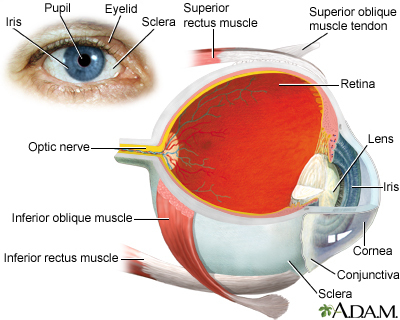
The conjunctiva is a thin, clear membrane that covers the inner surface of the eyelid and the white part of the eyeball (the sclera). It contains many tiny blood vessels.
Inflammation of the conjunctiva is called conjunctivitis. It makes the surface over the white part of the eye look red because the tiny blood vessels in the conjunctiva enlarge.
Sometimes a blood vessel may break, often for no apparent reason. The eye may be very red and look like it is bleeding. Actual blood almost never comes out of the eye because it is trapped under the clear layer of conjunctiva. This type of bleeding is called a subconjunctival hemorrhage.
Gallery
References
American Academy of Ophthalmology website. What is a subconjunctival hemorrhage? www.aao.org/eye-health/diseases/what-is-subconjunctival-hemorrhage. Published September 30, 2024. Accessed March 5, 2026.
Dutton JJ. Clinical anatomy of the eyelids. In: Yanoff M, Duker JS, eds. Ophthalmology. 6th ed. Philadelphia, PA: Elsevier; 2023:chap 12.1.