Healing at Home: Sue Hoffmann
UF Health Shands HomeCare is a comprehensive home health and personal care agency devoted to helping patients maintain an independent lifestyle or continue…

Dysarthria is a condition in which you have difficulty saying words because of problems with the muscles that help you talk. It does not affect your ability to understand language or know what you want to say.
Speech impairment; Slurred speech; Speech disorders - dysarthria
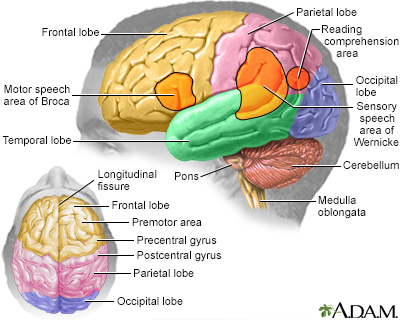
In a person with dysarthria, a nerve, brain, or muscle disorder makes it difficult to use or control the muscles of the mouth, tongue, larynx, or vocal cords.
The muscles may be weak, completely paralyzed, or unable to work together normally.
Dysarthria may be the result of brain damage due to:
Dysarthria may result from damage to the nerves that supply the muscles used for speaking, or to the muscles themselves from:
Dysarthria may be caused by diseases that affect nerves and muscles (neuromuscular diseases):
Other causes may include:
Depending on its cause, dysarthria may develop slowly or occur suddenly.
People with dysarthria may have difficulty pronouncing words clearly. Their speech may sound slurred, slow, fast, or uneven.
Other symptoms include:
Some people also have drooling or difficulty chewing or swallowing (dysphagia). They may have trouble moving their lips, tongue, or jaw.
Your health care provider will take a medical history and perform a physical exam. Family and friends may need to help with the medical history.
A procedure called laryngoscopy may be done. During this test, a flexible camera is passed through the mouth or nose to view the voice box (larynx).
Tests that may be done if the cause of the dysarthria is unknown include:
You may be referred to a speech and language therapist for testing and treatment. Special skills you may learn include:
You can use many different devices or techniques to help with speech, such as:
Surgery may help people with dysarthria.
Things that family and friends can do to communicate better with someone who has dysarthria include:
Listen carefully and allow the person to finish. Be patient. Make eye contact with them before speaking. Give positive feedback for their effort.
Depending on the cause of dysarthria, symptoms may improve, stay the same, or get worse slowly or quickly.
Contact your provider if you have:
Call 911 or the local emergency number right away if difficulty speaking develops suddenly, especially if it is accompanied by weakness, numbness, facial drooping, vision changes, severe dizziness, or confusion.
Kirshner HS. Dysarthria and apraxia of speech. In: Jankovic J, Mazziotta JC, Pomeroy SL, Newman NJ, eds. Bradley and Daroff's Neurology in Clinical Practice. 9th ed. Philadelphia, PA: Elsevier; 2027:chap 14.
Singer ML, Aihara K, Gonzalez-Fernandez M. Rehabilitation of swallowing disorders. In: Cifu DX, Bowles AO, Blessen CE, et al, eds. Braddom's Physical Medicine and Rehabilitation. 7th ed. Philadelphia, PA: Elsevier; 2026:chap 3.
UF Health Shands HomeCare is a comprehensive home health and personal care agency devoted to helping patients maintain an independent lifestyle or continue…
January 16, 2018
University of Florida neuroscientists are leading a multinational effort to track outcomes for patients with Tourette syndrome who undergo deep brain…
Department of Neurology, +4 more
