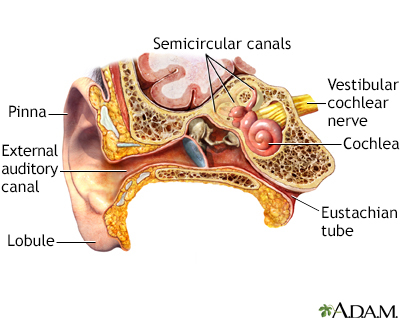
Definition
Hearing loss is being partly or totally unable to hear sound in one or both ears.
Alternative Names
Decreased hearing; Deafness; Loss of hearing; Conductive hearing loss; Sensorineural hearing loss; Presbycusis
Symptoms of hearing loss may include:
- Certain sounds seem overly loud in one ear
- Difficulty following conversations when two or more people are talking
- Difficulty hearing in noisy areas
- Trouble telling high-pitched sounds (such as "s" or "th") from one another
- Less trouble hearing men's voices than women's voices
- Hearing voices as mumbled or slurred
Associated symptoms may include:
- Feeling of being off-balance or dizzy (more common with Ménière disease and acoustic neuroma)
- Feeling of pressure in the ear (usually due to fluid behind the eardrum)
- Ringing or buzzing sound in the ears (tinnitus)
Causes
Conductive hearing loss (CHL) occurs because of a mechanical problem in the outer or middle ear. This may be because:
- Sound is not reaching the eardrum.
- The eardrum is not vibrating in response to sound.
- The 3 tiny bones of the ear (ossicles) are not conducting sound properly.
Causes of conductive hearing loss can often be treated. They include:
Sensorineural hearing loss (SNHL) occurs when the tiny hair cells (nerve endings) that detect sound in the inner ear are injured, diseased, do not work correctly, or have died. This type of hearing loss often cannot be reversed.
Sensorineural hearing loss is commonly caused by:
Hearing loss may be present at birth (congenital) and can be due to:
- Birth defects that cause changes in the ear structures
- Genetic conditions (more than 400 are known)
- Infections the mother passes to her baby in the womb, such as toxoplasmosis, rubella, or herpes
The ear can also be injured by:
Home Care
You can often flush wax buildup out of the ear (gently) with ear syringes (available in drug stores) and warm water. Wax softeners (such as Cerumenex) may be needed if the wax is hard and stuck in the ear.
Take care when removing foreign objects from the ear. Unless it is easy to get to, have your health care provider remove the object. Don't use sharp instruments to remove foreign objects.
See your provider for any other hearing loss.
When to Contact a Medical Professional
Contact your provider if:
- Hearing problems interfere with your lifestyle.
- Hearing problems do not go away or become worse.
- The hearing is worse in one ear than the other.
- You have sudden, severe hearing loss or ringing in the ears (tinnitus).
- You have other symptoms, such as ear pain, along with hearing problems.
- You have new headaches, weakness, or numbness anywhere on your body.
What to Expect at Your Office Visit
The provider will take your medical history and do a physical exam.
Tests that may be done include:
The following surgeries may help some types of hearing loss:
The following may help with long-term hearing loss:
Cochlear implants are only used in people who have lost too much hearing to benefit from a hearing aid.
References
Doyle EJ, Hertzano R, Tucci D, Samy RN. Sensorineural hearing loss in adults. In: Francis HW, Haughey BH, Hillel AT, et al, eds. Cummings Otolaryngology. 8th ed. Philadelphia, PA: Elsevier; 2026:chap 150.
Eggermont JJ. Types of hearing loss. In: Eggermont JJ, ed. Hearing Loss. Cambridge, MA: Elsevier Academic Press; 2017:chap 5.
Kerber KA, Baloh RW. Neuro-otology: diagnosis and management of neuro-otological disorders. In: Jankovic J, Mazziotta JC, Pomeroy SL, Newman NJ, eds. Bradley and Daroff's Neurology in Clinical Practice. 8th ed. Philadelphia, PA: Elsevier; 2022:chap 22.
Klimara MJ, Thorpe RJ, Smith RJH. Genetic sensorineural hearing loss. In: Francis HW, Haughey BH, Hillel AT, et al, eds. Cummings Otolaryngology. 8th ed. Philadelphia, PA: Elsevier; 2026:chap 148.
Le Prell CG, Hoffer ME. Noise-induced hearing loss. In: Francis HW, Haughey BH, Hillel AT, et al, eds. Cummings Otolaryngology. 8th ed. Philadelphia, PA: Elsevier; 2026:chap 152.