Obesity means weighing more than what is healthy for a given height. Obesity is a serious, chronic disease. It can lead to other health problems, including diabetes, heart disease, and some cancers.
Weight Loss Myths & Facts Quiz
Alternative Names
Morbid obesity; Fat - obese
Causes
Taking in more calories than your body uses can lead to obesity. This is because the body stores unused calories as fat. Obesity can be caused by:
Eating more food than your body can use
Drinking too much alcohol
Not getting enough exercise
Many people with obesity who lose large amounts of weight and gain it back think it is their fault. They blame themselves for not having the willpower to keep the weight off. Many people regain more weight than they lost.
Today, we know that biology is a big reason why some people cannot keep the weight off. Some people who live in the same place and eat the same foods develop obesity, while others do not. Our bodies have a complex system to keep our weight at a healthy level. In some people, this system does not work as well as it should.
The way we eat when we are children can affect the way we eat as adults.
The way we eat over many years becomes a habit. It affects what we eat, when we eat, and how much we eat.
We may feel that we are surrounded by things that make it easy to overeat and hard to stay active.
Many people feel they do not have time to plan and make healthy meals.
More people today work desk jobs compared to more active jobs in the past.
People with little free time may have less time to exercise.
Patient Education Video:Childhood obesity
The term eating disorder means a group of medical conditions that have an unhealthy focus on eating, dieting, losing or gaining weight, and body image. A person may have obesity, follow an unhealthy diet, and have an eating disorder all at the same time.
Sometimes, medical problems or treatments cause or contribute to weight gain, including:
Underactive thyroid (hypothyroidism)
Medicines such as birth control pills, antidepressants, and antipsychotics
Other things that can cause weight gain are:
Quitting smoking -- Many people who quit smoking gain 4 to 10 pounds (lb) or 2 to 5 kilograms (kg) in the first 6 months after quitting.
Stress, anxiety, feeling sad, or not sleeping well.
Menopause -- Women may gain 12 to 15 lb (5.5 to 7 kg) during menopause.
Pregnancy -- Women may not lose the weight they gained during pregnancy.
Exams and Tests
The health care provider will perform a physical exam and ask about your medical history, eating habits, and exercise routine.
The two most common ways to assess your weight and measure health risks related to your weight are:
Body mass index (BMI)
Waist circumference (your waist measurement in inches or centimeters)
BMI is calculated using height and weight. You and your provider can use your BMI to estimate how much body fat you have.
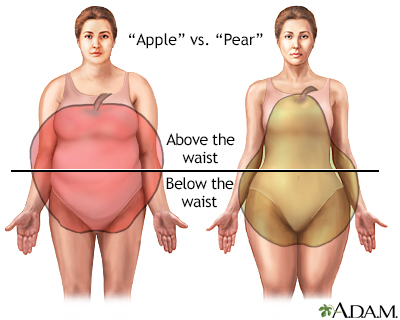
Your waist measurement is another way to estimate how much body fat you have. Extra weight around your middle or stomach area increases your risk for type 2 diabetes, heart disease, and stroke. People with "apple-shaped" bodies (meaning they tend to store fat around their waist and have a slim lower body) also have an increased risk for these diseases.
Treatment
CHANGING YOUR LIFESTYLE
An active lifestyle and plenty of exercise, along with healthy eating, is the safest way to lose weight. Even modest weight loss can improve your health. You may need a lot of support from family and friends.
Your main goal should be to learn new, healthy ways of eating and make them part of your daily routine.
Many people find it hard to change their eating habits and behaviors. You may have practiced some habits for so long that you may not even know they are unhealthy, or you do them without thinking. You need to be motivated to make lifestyle changes. Make the behavior change part of your life over the long term. Know that it takes time to make and keep a change in your lifestyle.
Work with your provider and dietitian to set realistic, safe daily calorie counts that help you lose weight while staying healthy. Remember that if you drop weight slowly and steadily, you are more likely to keep it off. Your dietitian can teach you about:
Extreme diets (fewer than 1,100 calories per day) are not thought to be safe or to work very well. These types of diets often do not contain enough vitamins and minerals. Most people who lose weight this way return to overeating and develop obesity again.
Learn ways to manage stress other than snacking. Examples may be meditation, yoga, or exercise. If you are depressed or stressed a lot, talk to your provider.
MEDICINES AND HERBAL REMEDIES
You may see ads for supplements and herbal remedies that claim they will help you lose weight. Some of these claims may not be true. And some of these supplements can have serious side effects. Talk to your provider before using them.
You can discuss weight loss medicines with your provider. Many people lose at least 5 lb (2 kg) by taking these drugs, but they may regain the weight when they stop taking the medicine unless they have made lifestyle changes.
SURGERY
Weight-loss surgery (also called metabolic and bariatric surgery or MBS) can reduce the risk of certain diseases in people with severe obesity. These risks include:
Surgery may help people who have had obesity for 5 years or more and have not lost weight from other treatments, such as diet, exercise, or medicine.
Providers often use body mass index (BMI) and health conditions such as type 2 diabetes and high blood pressure to determine which people are most likely to benefit from MBS.
Surgery alone is not the answer for weight loss. It can train you to eat less, but you still have to do much of the work. You must be committed to diet, control portion sizes of what you eat, and exercise after surgery. Talk to your provider to learn if surgery is a good option for you.
Obesity is a major health threat. The extra weight creates many risks to your health.
Gallery
References
Cowley MA, Brown WA, Considine RV. Obesity: the problem and its management. In: Jameson JL, De Groot LJ, de Kretser DM, et al, eds. Endocrinology: Adult and Pediatric. 7th ed. Philadelphia, PA: Elsevier Saunders; 2016:chap 26.
Eisenberg D, Shikora SA, Aarts E, et al. 2022 American Society for Metabolic and Bariatric Surgery (ASMBS) and International Federation for the Surgery of Obesity and Metabolic Disorders (IFSO): Indications for Metabolic and Bariatric Surgery. Surg Obes Relat Dis. 2022;18(12):1345-1356. PMID: 36280539 pubmed.ncbi.nlm.nih.gov/36280539/.
Jastreboff AM, Kotz CM, Kahan S, Kelly AS, Heymsfield SB. Obesity as a disease: The Obesity Society 2018 position statement. Obesity (Silver Spring). 2019;;27(1):7-9. PMID: 30569641. pubmed.ncbi.nlm.nih.gov/30569641/.
Oh TJ. The role of anti-obesity medication in prevention of diabetes and its complications. J Obes Metab Syndr. 2019;28(3):158-166. PMID: 31583380 pubmed.ncbi.nlm.nih.gov/31583380/.
Pilitsi E, Farr OM, Polyzos SA, et al. Pharmacotherapy of obesity: available medications and drugs under investigation. Metabolism. 2019;92:170-192. PMID: 30391259 pubmed.ncbi.nlm.nih.gov/30391259/.
Raynor HA, Champagne CM. Position of the Academy of Nutrition and Dietetics: interventions for the treatment of overweight and obesity in adults.J Acad Nutr Diet. 2016;116(1):129-147. PMID: 26718656 pubmed.ncbi.nlm.nih.gov/26718656/.
Richards WO, Khatian L, Torquati A. Morbid obesity. In: Townsend CM Jr, Beauchamp RD, Evers BM, Mattox KL, eds. Sabiston Textbook of Surgery. 21st ed. St. Louis, MO: Elsevier; 2022:chap 48.
Ryan DH, Kahan S. Guideline Recommendations for obesity management. Med Clin North Am. 2018;102(1):49-63. PMID: 29156187 pubmed.ncbi.nlm.nih.gov/29156187/.
Semlitsch T, Stigler FL, Jeitler K, Horvath K, Siebenhofer A. Management of overweight and obesity in primary care-A systematic overview of international evidence-based guidelines. Obes Rev. 2019;20(9):1218-1230. PMID: 31286668 pubmed.ncbi.nlm.nih.gov/31286668/.
Last reviewed January 17, 2022 by David C. Dugdale, III, MD, Professor of Medicine, Division of General Medicine, Department of Medicine, University of Washington School of Medicine. Also reviewed by David Zieve, MD, MHA, Medical Director, Brenda Conaway, Editorial Director, and the A.D.A.M. Editorial team. Editorial update 02/21/2023..
UF Health research scientists make medicine better every day. They discover new ways to help
people by running clinical trials. When you join a clinical trial, you can get advanced
medical care. Sometimes years before it's available everywhere. You can also help make
medicine better for everyone else.
If you'd like to learn more about clinical trials, visit our
clinical trials page. Or click one of the links below:
This study is open to adults who are at least 18 years old and have
a body mass index (BMI) of 30 kg/m² or more, or
a BMI of 27 kg/m² or more and at least one health problem related to their weight.
People with type 2 diabetes cannot take part…
This study is open to adults who are at least 18 years old and have a body mass index of 27 kg/m² or more. People can take part if they have type 2 diabetes and if they are currently being treated only with diet and exercise or with specific…
March 15 marks World Sleep Day — a great time to emphasize the significance of children’s sleep wellness, as research shows high-quality sleep is crucial for…
A University of Florida Health pulmonologist has been appointed chair of a new state task force to study blood clots and make policy recommendations to protect…
Obesity is one of the most common chronic health conditions across the United States — and the world.
Although there are a variety of treatments, ranging from lifestyle changes to medication, much...
Obesity comes with a slew of health consequences and roughly 42% of American adults are obese. This contributes to the ongoing Type 2 diabetes epidemic, with ever greater numbers of people being...
Sometimes, you open a bag of chips. And sometimes, five minutes later, you reach into that same bag and come up empty. Late-night snacking can be a dietary sore point for many of us, and...