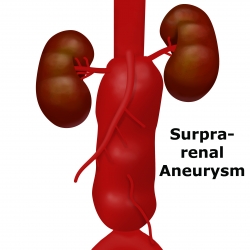
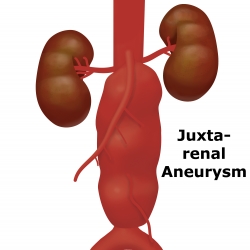
The aorta is the main blood vessel that travels from the heart delivering arterial blood to all the extremities and organs in the body. An abdominal aortic aneurysm (AAA) refers to when the diameter or size of the aorta located in the abdomen becomes enlarged. As the wall of the aorta weakens, this “bulge” in the aorta can become larger from pressurized blood passing through it. AAAs can form in any of the following locations:
Below the kidneys (infrarenal)
At the same level as the kidneys (juxtarenal)
Above the kidneys (suprarenal)
The decision to treat AAAs is based on several factors, the most important of which is size. The general recommendation is to repair AAAs when they reach 5.0 – 5.5cm in diameter, as the risk of rupture becomes significant.
Causes & Risk Factors
Atherosclerosis, hardening of the arteries caused by plaque buildup, plays an important role in the development of abdominal aortic aneurysms. Over time, this plaque can cause the walls of the aorta to become stiff and weak, creating the potential for an aneurysm to form.
Some factors that increase your risk for atherosclerosis (and increase your risk for developing an abdominal aortic aneurysm) are:
Smoking
High blood pressure
High cholesterol
Being overweight
A family history of cardiovascular disease
Other factors that increase your risk for developing an abdominal aortic aneurysm are:
Age (greater than 60)
Gender (incidence in males is 4 to 5 times greater than in females)
Family history of aneurysms
Genetic disorders that effect connective tissue such as Marfan Syndrome, Ehlers-Danlos syndrome, Loeys-Dietz syndrome.
Infections such as syphilis, salmonella or staphylococcus
Trauma/injury
Congenital syndromes that are present since birth such as a bicuspid aortic valve or coarctation of the aorta
Symptoms
The majority of patients who have AAAs have no symptoms. However, in those rare instances when symptoms do occur, they may include the following:
Pain in the chest, abdomen, lower back or groin area that does not decrease with medication or change of position
A pulsing sensation that feels like a heartbeat in the abdomen
Diagnosis
In addition to your physician getting your complete medical history and doing a physical exam, the following tests may be used for diagnostic purposes:
Ultrasound
Computed Tomography (CT) Scan
Magnetic Resonance Imaging (MRI)
Arteriogram (Angiogram)
Early diagnosis is often critical for managing the condition most effectively.
Treatment
After taking into consideration the size and location of your aneurysm along with your medical history, risk factors, and overall health status, your doctor will explain and recommend the most suitable treatment. Treatment options include:
Medical management (blood pressure control, smoking cessation, etc.)
Surgery
Open Repair
Open repair of an AAA is a procedure that has been performed for over 50 years. It involves making an incision on the abdomen in order to visualize and replace the diseased segment of aorta with a new tube (e.g., a synthetic graft).
Endovascular aortic aneurysm repair is a minimally invasive method used to treat aortic disease. Through small incisions in the groin, wires and catheters are inserted into the aorta using X-rays and contrast/dye to deploy a stent-graft within the diseased segment of aorta effectively excluding the aneurysm from pressurized arterial blood. Specific anatomic requirements are necessary to safely utilize this technology. Some complex stent-grafts have holes (fenestrations) in them to permit blood flow to critical branches that originate off the aorta. In addition, endovascular repairs require long-term follow-up with CT scans.
UF Health research scientists make medicine better every day. They discover new ways to help
people by running clinical trials. When you join a clinical trial, you can get advanced
medical care. Sometimes years before it's available everywhere. You can also help make
medicine better for everyone else.
If you'd like to learn more about clinical trials, visit our
clinical trials page. Or click one of the links below:
The purpose of the study is to assess the safety and effectiveness of the GORE® EXCLUDER® Conformable AAA Endoprosthesis to treat an infrarenal aneurysm located in the abdominal aorta. Performance of the GORE® EXCLUDER® Conformable AAA…
The purpose of this randomized clinical trial is to treat patients with small to mid-sized abdominal aortic aneurysms (AAA), maximum diameter of 3.5 cm to 5.0 cm, using a locally delivered, single-dose endovascular treatment. The main question the…
Investigator
Samir K Shah
Status
Accepting Candidates
Ages
21 Years - 85 Years
Sexes
All
News and Patient Stories: Abdominal aortic aneurysm
University of Florida Health Shands Hospital, a perennial leader in health care in Florida, was again recognized Tuesday by U.S. News & World Report’s Best…
UF Health Wellness University is kicking off December with four free seminars on Thursday at the Hilton University of Florida Conference Center. Those…