Definition
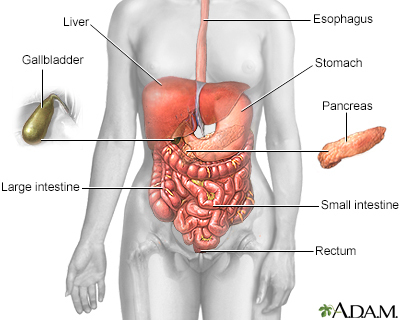
Bile is a fluid that is made and released by the liver and stored in the gallbladder.
Bile helps with digestion. It breaks down fats into fatty acids, which can be taken into the body by the digestive tract.
Bile contains:
- Cholesterol
- Bile acids (also called bile salts)
- Bilirubin (a breakdown product of red blood cells)
It also contains:
- Water
- Body salts (such as potassium and sodium)
- Copper and other metals (attached to proteins)
References
Cratchley AL, Rotimi O, Haugk B. Liver, biliary system and pancreas. In: Cross SS, ed. Underwood's Pathology. 8th ed. Philadelphia, PA: Elsevier; 2025:chap 16.
Hall JE, Hall ME. Secretory functions of the alimentary tract. In: Hall JE, Hall ME, eds. Guyton and Hall Textbook of Medical Physiology. 15th ed. Philadelphia, PA: Elsevier; 2026:chap 65.
Martin P. Approach to the patient with liver disease. In: Goldman L, Cooney KA, eds. Goldman-Cecil Medicine. 27th ed. Philadelphia, PA: Elsevier; 2024:chap 132.