Definition
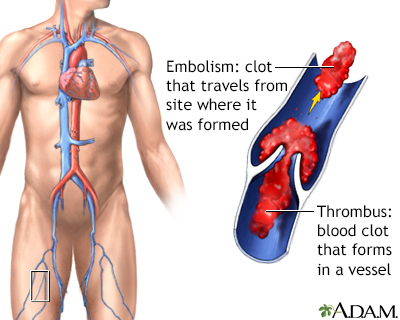
Blood clots are clumps that occur when blood hardens from a liquid to a solid.
- A blood clot that forms inside one of your veins or arteries is called a thrombus. A thrombus may also form in your heart.
- A thrombus that breaks loose and travels from one location in the body to another is called an embolus.
A thrombus or embolus can partly or completely block the flow of blood in a blood vessel.
- A blockage in an artery may prevent oxygen from reaching the tissues in that area. This is called ischemia. If ischemia is not treated promptly, it can lead to tissue damage or death.
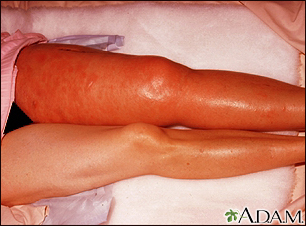
- A blockage in the vein will often cause fluid buildup and swelling.
Alternative Names
Clot; Emboli; Thrombi; Thromboembolus; Hypercoagulable state
Causes
Situations in which a blood clot is more likely to form in veins include:
- Being on long-term bed rest
- Sitting for long periods, such as in a plane or car
- During and after pregnancy
- Taking birth control pills or estrogen hormones (especially in women who smoke)
- Long-term use of an intravenous catheter
- After surgery
Blood clots are also more likely to form after an injury. People with cancer, obesity, and liver or kidney disease are also prone to blood clots.
Smoking also increases the risk of forming blood clots.
Conditions that are passed down through families (inherited) may make you more likely to form abnormal blood clots. Inherited conditions that affect clotting are:
- Factor V Leiden mutation
- Prothrombin G20210A mutation
Other rare conditions, such as protein C, protein S, and antithrombin III deficiencies.
A blood clot may block an artery or vein in an organ, affecting the:
References
Anderson JA, Hogg KE, Weitz JI. Hypercoagulable states. In: Hoffman R, Benz EJ, Silberstein LE, et al, eds. Hematology: Basic Principles and Practice. 7th ed. Philadelphia, PA: Elsevier; 2018:chap 140.
Cross SS. Ischaemia, infarction and shock . In: Cross SS, ed. Underwood's Pathology. 7th ed. Philadelphia, PA: Elsevier; 2019:chap 7.
Schafer AI. Approach to the patient with bleeding and thrombosis: hypercoagulable states. In: Goldman L, Schafer AI, eds. Goldman-Cecil Medicine. 26th ed. Philadelphia, PA: Elsevier; 2020:chap 162.