Are You at Risk of a Hernia?
Almost everyone has heard of a hernia, but few understand its potential risks. Over five million people in the United States will suffer from a hernia, yet…

Update your location to show providers, locations, and services closest to you.
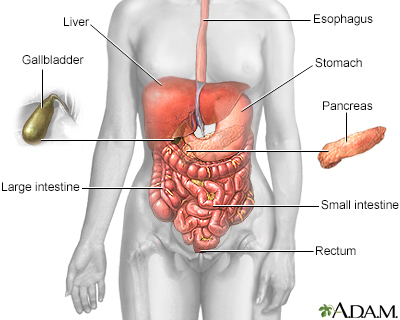
Gastroesophageal reflux disease (GERD) is a condition in which the stomach contents leak backward from the stomach into the esophagus (food pipe). Food travels from your mouth to the stomach through your esophagus. GERD can irritate the food pipe and cause heartburn and other symptoms.
Peptic esophagitis; Reflux esophagitis; GERD; Heartburn - chronic; Dyspepsia - GERD
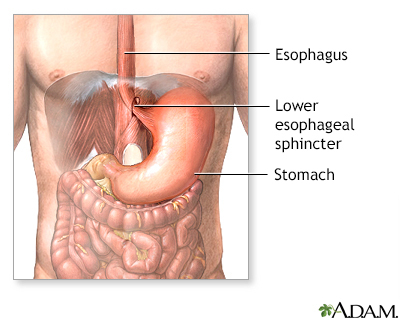
When you eat, food passes from the throat to the stomach through the esophagus. A ring of muscle fibers in the lower esophagus prevents swallowed food from moving back up. These muscle fibers are called the lower esophageal sphincter (LES).
When this ring of muscle does not close all the way, stomach contents can leak back into the esophagus. This is called reflux or gastroesophageal reflux. Reflux may cause symptoms. Harsh stomach acids can also damage the lining of the esophagus.
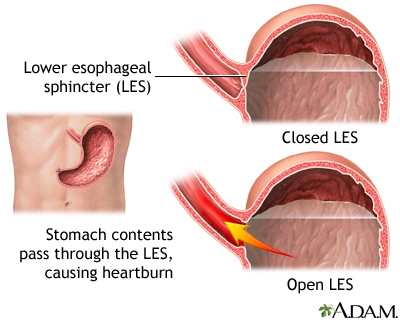
The risk factors for reflux include:
Heartburn and gastroesophageal reflux can be caused by or made worse by pregnancy. Symptoms can also be caused by certain medicines, such as:
Talk to your health care provider if you think one of your medicines may be causing heartburn. Never change or stop taking a medicine without first talking to your provider.
Common symptoms of GERD include:
Less common symptoms are:
Symptoms may get worse when you bend over or lie down, or after you eat. Symptoms may also be worse at night.
You may not need any tests if your symptoms are mild.
If your symptoms are severe or they come back after you have been treated, your provider may recommend a test called an upper endoscopy (EGD).
You may also be recommended to have one or more of the following tests:
A positive stool occult blood test may diagnose bleeding that is coming from the irritation in the esophagus, stomach, or intestines.
You can make many lifestyle changes to help treat your symptoms.
Other tips include:
You may use over-the-counter antacids after meals and at bedtime, although the relief may not last very long. Common side effects of antacids include diarrhea or constipation.
Other over-the-counter and prescription medicines can treat GERD. They work more slowly than antacids, but give you longer relief. Your pharmacist, doctor, or nurse can tell you how to take these medicines.
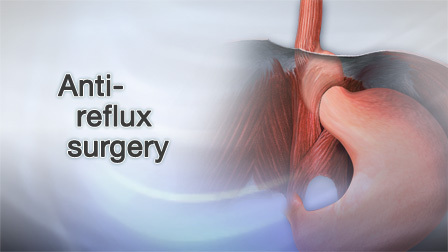
Anti-reflux surgery may be an option for people whose symptoms do not go away with lifestyle changes and medicines. Heartburn and other symptoms should improve after surgery. But you may still need to take medicines for your heartburn.
There are also new therapies for reflux that can be performed through an endoscope (a flexible tube passed through the mouth into the stomach).
Most people respond to lifestyle changes and medicines. However, many people need to continue taking medicines to control their symptoms.
Complications may include:
Contact your provider if symptoms do not improve with lifestyle changes or medicine.
Also call if you have:
Avoiding factors that cause heartburn may help prevent symptoms. Obesity is linked to GERD. Maintaining a healthy body weight may help prevent the condition.
ASGE Standards of Practice Committee, Muthusamy VR, Lightdale JR, et al. The role of endoscopy in the management of GERD. Gastrointest Endosc. 2015;81(6):1305-1310. PMID: 25863867 pubmed.ncbi.nlm.nih.gov/25863867/.
Falk GW, Katzka DA. Diseases of the esophagus. In: Goldman L, Schafer AI, eds. Goldman-Cecil Medicine. 26th ed. Philadelphia, PA: Elsevier; 2020:chap 129.
National Institute of Diabetes and Digestive and Kidney Diseases website. Acid reflux (GER & GERD) in adults. www.niddk.nih.gov/health-information/digestive-diseases/acid-reflux-ger-gerd-adults. Updated July 2020. Accessed February 6, 2023.
Richter JE, Vaezi MF. Gastroesophageal reflux disease. In: Feldman M, Friedman LS, Brandt LJ, eds. Sleisenger and Fordtran's Gastrointestinal and Liver Disease. 11th ed. Philadelphia, PA: Elsevier; 2021:chap 46.

Almost everyone has heard of a hernia, but few understand its potential risks. Over five million people in the United States will suffer from a hernia, yet…
Eittel E. Oppenheimer, MD, a board-certified gastrointestinal surgeon in the University of Florida Department of Surgery, provides an expert’s perspective on…
