Steps for Preventing Colorectal Cancer in Young Adults
Colorectal cancer is occurring far more often in those under 50 — a trend that’s held for the last decade. With regular screenings, however, the cancer is both…

Rectal bleeding is when blood passes from the rectum or anus. Bleeding may be noted on the stool or be seen as blood on toilet paper or in the toilet. The blood may be bright red. The term "hematochezia" is used to describe this finding.
Rectal bleeding; Blood in the stool; Hematochezia; Lower gastrointestinal bleeding; Melena
The color of the blood in the stools may indicate the source of bleeding.
Black or tarry stools (melena) may be due to bleeding in the upper part of the GI (gastrointestinal) tract, such as the esophagus, stomach, small intestine or right colon. In this case, blood is most often darker because it gets digested on its way through the GI tract. Much less commonly, upper GI bleeding can be brisk enough to present with bright red rectal bleeding.
Bleeding from the rectum may also be red or fresh. This usually means that the source of bleeding is the lower GI tract (colon, rectum, and anus).
Eating beets or foods with red food coloring can sometimes make stools appear reddish. In these cases, your health care provider can test the stool with a chemical to check for the presence of blood.
If a person has dangerously low blood pressure or other signs of unstable circulation is unstable, they need immediate treatment.
Rectal bleeding causes include:
Contact your provider if there is:
You should see your provider and have an exam, even if you think that hemorrhoids are causing the blood in your stool.
In children, a small amount of blood in the stool is most often not serious. The most common cause is constipation. You should still tell your child's provider if you notice this problem.
Your provider will take a medical history and perform a physical exam. The exam will focus on your abdomen and rectum.
You may be asked the following questions:
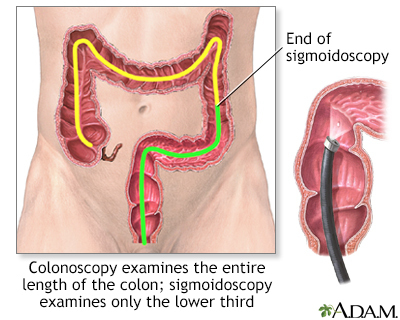
You may need to have one or more exams or tests to look for the cause:
You may have one or more lab tests before, including:


DeGeorge LM, Nable JV. Gastrointestinal bleeding. In: Walls RM, ed. Rosen's Emergency Medicine: Concepts and Clinical Practice. 10th ed. Philadelphia, PA: Elsevier; 2023:chap 26.
Kovacs TO, Jensen DM. Gastrointestinal hemorrhage. In: Goldman L, Cooney KA, eds. Goldman-Cecil Medicine. 27th ed. Philadelphia, PA: Elsevier; 2024:chap 121.
Kwaan MR. Hemorrhoids, anal fissure, and anorectal abscess and fistula. In: Kellerman RD, Heidelbaugh JJ, Lee EM, eds. Conn's Current Therapy 2026. Philadelphia, PA: Elsevier; 2026:241-244.
Savides TJ, Jensen DM. Gastrointestinal bleeding. In: Chung RT, Rubin DT, Wilcox CM, eds. Sleisenger and Fordtran's Gastrointestinal and Liver Disease. 12th ed. Philadelphia, PA: Elsevier; 2026:chap 21.
Colorectal cancer is occurring far more often in those under 50 — a trend that’s held for the last decade. With regular screenings, however, the cancer is both…
Colorectal cancer is the third most common cancer in the U.S., and second-leading cause of death, taking 50,000 lives each year. However, thanks to years of…
